

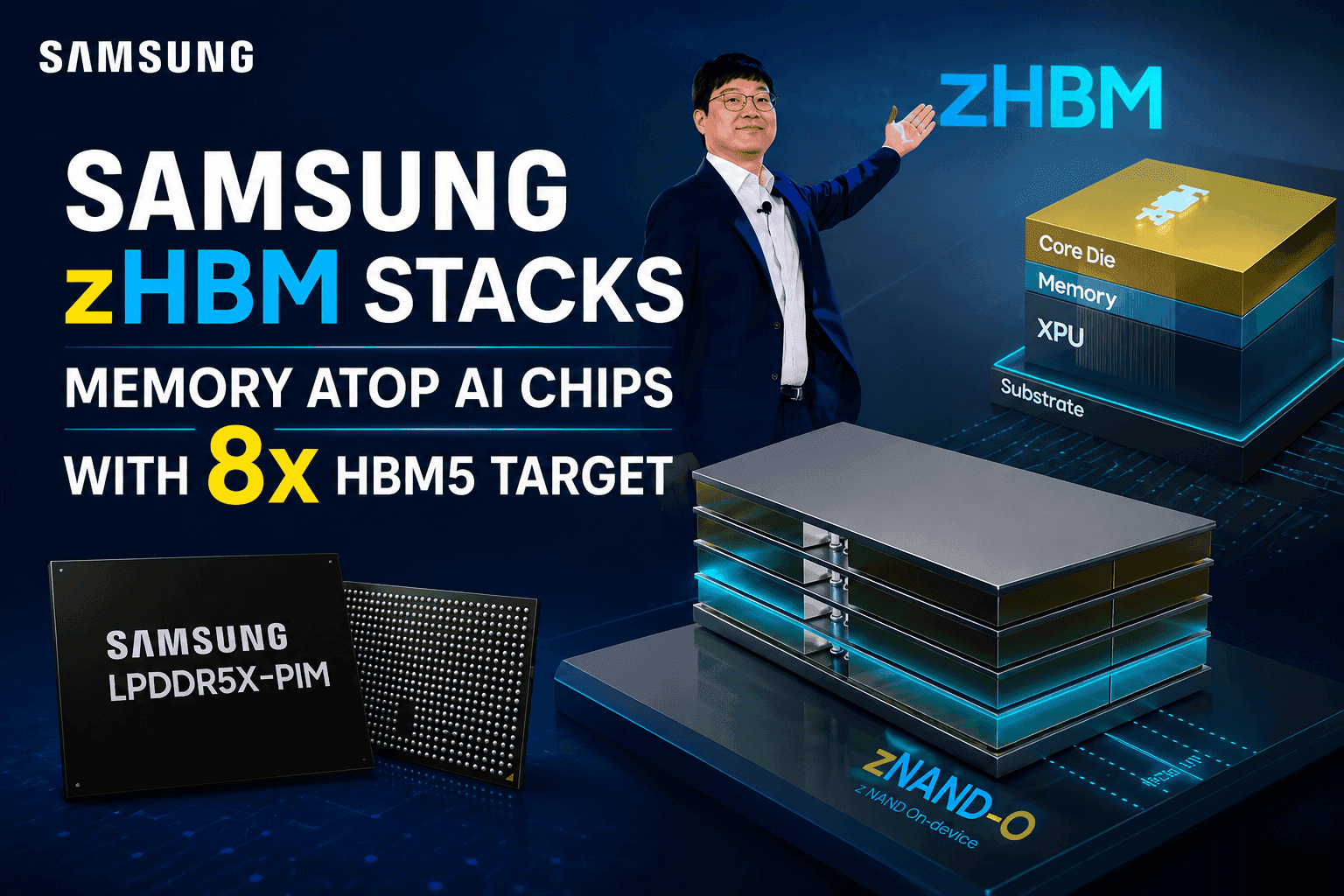
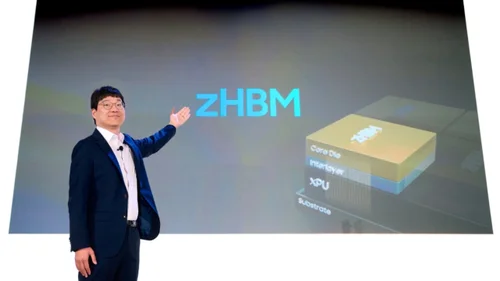
Samsung Electronics unveiled zHBM on August 4, 2026 at Future of Memory and Storage 2026 in Santa Clara. The 3D memory design stacks high-bandwidth memory directly above AI accelerators and targets roughly eight times HBM5 performance. Samsung zHBM aims at AI data centers, and that decision reaches your Galaxy anyway.
Key Takeaways
- Samsung showed the industry's first zHBM and zNAND-O concept models at FMS 2026, placing high-bandwidth memory on top of the AI accelerator instead of beside it.
- Samsung projects roughly eight times the performance of HBM5, more than ten times the memory density, three times better energy use and more than 50% lower thermal resistance.
- The company gave no launch window for zHBM, and it benchmarks the design against HBM5, a specification the industry has not ratified.
- V10 BV-NAND is the one FMS reveal with a near-term path to products, crossing 400 layers with roughly 58% higher density than V9.
- Galaxy owners feel this announcement through pricing rather than specs, because AI memory keeps pulling wafer capacity away from mobile DRAM.
Samsung Put zHBM, zNAND-O and 400-Layer NAND on Stage at FMS 2026
Samsung displayed concept models of zHBM and zNAND-O at the Santa Clara Convention Center, according to its Samsung Newsroom release. The company calls both an industry first. Its AI cloud server-themed booth carried around 30 memory and storage technologies.
Two executives ran the opening keynote. Jin-Yub Lee, Executive Vice President and Head of Flash Product & Technology, shared the stage with Kyungryun Kim, Vice President and Project Leader of the DRAM Design Team. Samsung titled the session "Driving the Wave of AI Revolution: 3D Innovations in Memory & Storage Architecture."
The third reveal ships soonest. V10 BV-NAND crosses 400 layers and raises density about 58% over V9, per Samsung. That milestone lands 13 years after Samsung showed the first V-NAND at the 2013 Flash Memory Summit.
PhoneArena's Mariyan Slavov summed up the consumer read on August 5, calling the odds of this memory reaching your next phone, PC, GPU or console small. He is right about the hardware. He stops short of the money.
How zHBM Breaks From HBM5 and Every HBM Layout Before It
Conventional HBM sits beside the processor, wired across an interposer. zHBM sits directly on top of the accelerator. Data travels a shorter distance, which lifts bandwidth and lowers power draw.
The Korea Herald described the change plainly in its report that Samsung stacks HBM atop AI chips. Samsung frames the goal as feeding large-scale AI training and inference without starving the compute die.
Samsung is not the first company to want this. Tom's Hardware notes that SK hynix and its partners weighed stacking HBM4 on logic dies years ago. Cooling, power delivery and interposers built for a 2,048-bit interface all blocked the idea.
Does the heat problem vanish because Samsung drew a better diagram? Samsung says thermal resistance falls by more than half. Thermal resistance depends on the finished package, not on any standard.
zHBM also accepts customer-specific IP in the interlayer between memory and accelerator. That makes it a semi-custom product rather than a plain JEDEC part.
Key Details: The zHBM Numbers Samsung Confirmed
| Metric | zHBM target versus HBM5 |
|---|---|
| System performance | Approximately 8 times |
| Memory density | More than 10 times |
| Energy use | 3 times better |
| Thermal resistance | More than 50% lower |
| Memory placement | Above the accelerator, not alongside it |
| Custom IP | Supported in the interlayer between memory and logic |
Samsung published no launch window for zHBM. Anton Shilov at Tom's Hardware reads the technology as years away, since HBM5 itself arrives late this decade at the earliest.
The shipping roadmap around the concept is concrete. Samsung mass-produced HBM4 in February 2026 on 1c DRAM with a 4-nanometer base die. It shipped the first HBM4E samples to global customers in May 2026.
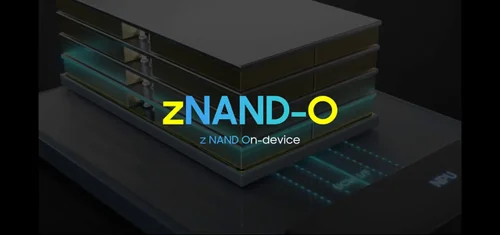
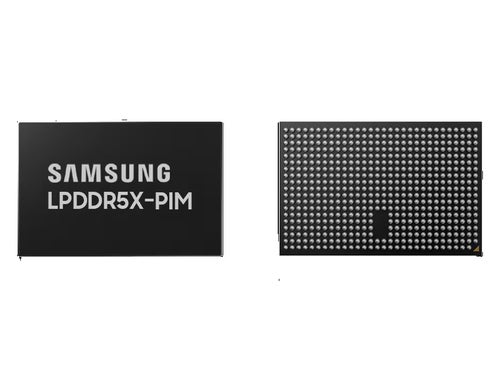
Samsung also showed LPDDR5X-PIM, the first LPDDR memory with processing-in-memory, plus its PM1763 and BM1773 enterprise drives. zNAND-O is in development in four-layer and eight-layer versions for edge AI.
PRO TIP: Read "8 times the performance of HBM5" as a system-level figure. Samsung never wrote 8x bandwidth, and Tom's Hardware flagged that wording as deliberately loose.
What's Confirmed and What's Still Unclear About Samsung zHBM
Confirmed: Samsung unveiled zHBM and zNAND-O concept models at FMS 2026 on August 4, 2026, per its own newsroom release.
Still Unclear: Samsung disclosed no mass production date, no customer and no bonding technology for zHBM.
What It Means: Treat zHBM as a roadmap statement aimed at AI accelerator customers, not a product you can buy or benchmark.
Confirmed: Samsung compares zHBM against HBM5 across performance, density, energy use and thermal resistance.
Still Unclear: HBM5 has no ratified specification, so the baseline for every one of those multiples keeps moving.
What It Means: Nobody can verify the 8x claim today. File it under vendor projection until silicon exists.
Confirmed: V10 BV-NAND uses wafer bonding, passes 400 layers and reaches 28 Gb per square millimeter with I/O up to 5,600 MT/s, per Tom's Hardware.
Still Unclear: Samsung named no consumer SSD or Galaxy device that will carry it first.
What It Means: BV-NAND is the FMS reveal most likely to touch a product you own, probably inside a drive rather than a phone.
Confirmed: Samsung designed all three technologies for HPC and AI infrastructure workloads.
Still Unclear: Samsung has said nothing about whether zHBM techniques ever scale down to mobile packaging.
What It Means: Your next Galaxy gets LPDDR and UFS, priced by a market these AI parts increasingly control.
What Samsung's 3D Memory Push Means for Your Galaxy Phone
zHBM will never sit inside a Galaxy phone. The capacity behind it already changed what you pay for one.
Won-Joon Choi, COO of Samsung's Mobile eXperience business, told The Verge in February that the memory shortage made a "significant contribution" to Galaxy S26 pricing. The S26 and S26+ arrived $100 above their predecessors.
The squeeze got worse through the spring. TrendForce estimated LPDDR5X contract prices rising 78% to 83% quarter over quarter in the second quarter of 2026, with LPDDR4X up 70% to 75%. Korean suppliers tightened full-year allocations for smartphone clients to feed AI servers first.
Foldables took the next hit. The Korea Herald reported in July that the Galaxy Z Flip8 would launch around 13% above the Flip7, near 1.68 million won for the 256GB model, citing distributor pricing from Bloter.
Here is the connection nobody made at FMS. zHBM, zNAND-O and BV-NAND all depend on wafer bonding, and every bonding line Samsung dedicates to AI memory competes with mobile DRAM and UFS for tools, cleanroom space and engineers.
How much are you willing to pay for 16GB of RAM in a phone next year? TrendForce projects global smartphone production dropping more than 10% year over year in 2026 under exactly this cost pressure.
WARNING: Buying a Galaxy on a two-year cycle looks expensive in this market. Memory contract prices have climbed for three straight quarters, and Samsung negotiated further commodity DRAM increases for the third quarter.
Longer ownership makes support windows matter more than launch specs. Check your model against the August 2026 Samsung software update roadmap before you commit to skipping an upgrade cycle. Samsung's habit of debuting new technology on premium hardware first shows up across the company, most recently with HDR10+ Advanced landing first on its 2026 TVs.
Frequently Asked Questions About Samsung zHBM
Q: What is Samsung zHBM?
A: Samsung zHBM is a 3D memory architecture that stacks high-bandwidth memory vertically above an AI accelerator instead of placing it alongside the processor. Samsung revealed concept models at FMS 2026 on August 4, 2026. The design targets roughly eight times the performance of HBM5 for AI training and inference workloads.
Q: When will Samsung zHBM be available?
A: Samsung has not announced a production date, a customer or a shipping window. The company benchmarks zHBM against HBM5, which industry roadmaps place in the late 2020s or early 2030s. Tom's Hardware describes the technology as years away from market.
Q: Will zHBM come to Samsung Galaxy phones?
A: No. Samsung built zHBM for AI data centers and high-performance computing, where power and thermal budgets dwarf anything in a phone. Galaxy devices continue using LPDDR mobile DRAM and UFS storage. The mobile effect from this 3D memory push runs through supply and pricing instead.
Q: How is zHBM different from HBM5?
A: HBM5 keeps memory beside the processor and connects it through an interposer. zHBM places the stack directly on top of the accelerator, shortening the data path. Samsung claims more than ten times the density, three times better energy use and more than 50% lower thermal resistance against HBM5.
Q: Why are Samsung phone prices rising because of AI memory?
A: Memory makers route limited wafer capacity toward HBM and AI server DRAM, which starves the mobile market. TrendForce measured LPDDR5X contract prices climbing 78% to 83% in one quarter. Samsung's own mobile COO named the shortage as a reason the Galaxy S26 costs $100 more than the S25.
What to Watch After the FMS 2026 Keynote
Watch for a named zHBM customer before you take the 8x figure seriously. Samsung sells this design as semi-custom, so the first announced accelerator partner will reveal far more than any spec sheet.
The nearer signal is V10 BV-NAND reaching retail drives, since 400-layer NAND with 5,600 MT/s I/O changes storage pricing long before Samsung zHBM changes anything. Fourth-quarter memory contract pricing tells you what your next Galaxy costs.
Samsung's consumer wins this month came from software rather than silicon, including the Samsung Wallet paperless ticket launch for Korail trains. That gap between the memory division and the phone division is the story to track.
Are you holding your current Galaxy longer because of memory pricing, or upgrading anyway? Drop your model and what you paid in the comments, especially if you bought a Z Flip8 after the price bump.









Responses (0 )